Readings With Context
A temperature number detached from its physical context is operational noise. Whether a display reads +4.2 °C or −19.5 °C, that figure only becomes meaningful evidence when you know what medium the sensor is measuring, where it sits relative to supply and return air streams, when it was last calibrated across its operating range, and how frequently it samples.
At custody handovers, disputes arise most often when one party points to a refrigeration controller’s setpoint display while the receiving party inspects a cargo data logger or core product probe.
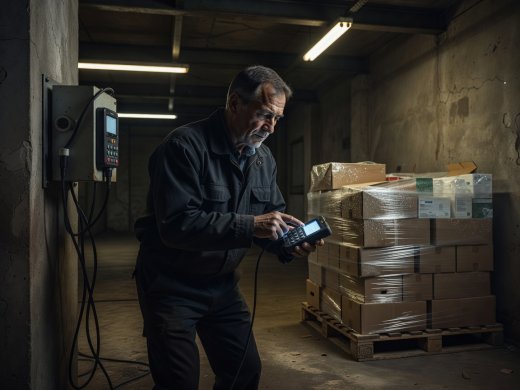
Air Temperature Versus Product Core Temperature
Air has low density and low specific heat capacity; its temperature swings rapidly whenever an evaporator enters a defrost cycle or a personnel door opens for thirty seconds. Dense palletized products—whether liquid vials, dairy cartons, or boxed meat—possess substantial thermal mass and respond much more slowly to transient air fluctuations.
To prevent nuisance alarms without masking genuine equipment failure, fixed warehouse monitoring systems frequently pair bare-air probes with buffered probes immersed in propylene glycol, glass beads, or machined aluminum blocks. The buffer slows the probe’s thermal time constant so that it mimics the rate of heat transfer experienced by a representative unit of stock. However, buffered probes must never be used to excuse poor door discipline; monitoring both air and buffered channels reveals mechanical degradation early while reserving urgent product quarantine actions for genuine load-level threat.
Supply Air vs. Return Air in Reefers
In transport refrigeration units, the supply air sensor sits immediately downstream of the evaporator coil and measures the coldest air entering the cargo space. The return air sensor measures air coming back from the load after picking up heat from walls and cargo. For freeze-sensitive goods, monitoring only return air is hazardous: if the return air is slightly warm, the controller may drive supply air well below 0 °C, freezing top-layer cartons positioned directly in front of the delivery chute.
Comparing Cold-Chain Monitoring Instruments
| Instrument Class | Typical Sensor Element | Operational Strengths | Operational Limitations & Risks |
|---|---|---|---|
| Precision Fixed RTDs (Pt100 / Pt1000) | Platinum resistance thermometer | High long-term stability, wide range (−200 °C to +100 °C+), suited for hardwired warehouse EMS and ultra-low freezers. | Requires 3-wire or 4-wire lead compensation; installation cost limits density unless paired with wireless nodes. |
| USB / BLE Transit Loggers | NTC thermistor or digital silicon sensor | Travels inside the actual load; independent of carrier telematics; generates tamper-evident PDF/CSV audit files at destination. | Data is retrospective unless paired with gateway readers; single-use units require verified lot calibration certificates. |
| Cellular / IoT Real-Time Trackers | Multi-sensor (temp, light, shock, GNSS) | Provides live in-transit alerts for door openings, route delays, and early drift so operators can intervene mid-journey. | Signal attenuation inside thick metallic containers or deep vessel holds; battery chemistry degrades at cryogenic extremes. |
| Infrared (IR) Surface Thermometers | Thermopile optical detector | Rapid non-destructive screening at loading docks without puncturing primary packaging. | Measures only outer cardboard surface (emissivity errors and frost reflection); never equals internal core product temperature. |
Calibration Traceability, EN 12830, and Mean Kinetic Temperature
A sensor’s stated factory accuracy only holds if verified against reference standards traceable to national metrology institutes (such as NPL, NIST, or PTB) via ISO/IEC 17025 accredited laboratories. A multi-point calibration performed bracketing the actual working range (for example, −25 °C, 0 °C, and +10 °C) exposes non-linear sensor drift that a single-point room-temperature check misses completely.
In European food cold-chain transport and storage, standard EN 12830 specifies technical and functional characteristics for temperature recorders, while EN 13486 sets out periodic verification procedures. In pharmaceutical distribution, electronic records generated by environmental monitoring systems must also satisfy data integrity controls (such as 21 CFR Part 11 and EU GMP Annex 11), ensuring audit trails, time-stamp synchronization, and secure user access.
The Boundaries of Mean Kinetic Temperature (MKT)
Mean Kinetic Temperature is a non-linear calculation (derived from the Arrhenius equation) that expresses the cumulative thermal stress experienced by a product over a period of varying temperatures as a single equivalent isothermal value. Because degradation rates accelerate exponentially as temperature rises, MKT weights warm spikes more heavily than an arithmetic mean. Crucially, MKT is not a universal pass card for excursions: it cannot account for phase changes such as freezing of liquid biologics or melting of emulsions, and regulatory guidance restricts its use to evaluating short-term deviations where stability data supports the calculation.