Insulation Performance
K-Values, Aging Foam, and the ATP Framework
The insulating effectiveness of a transport body is measured by its overall heat transfer coefficient, known as the K-value (expressed in $\text{W}/(\text{m}^2\cdot\text{K})$). Under the UNECE Agreement on the International Carriage of Perishable Foodstuffs (ATP), equipment classified as heavily insulated ($I_R$) must demonstrate a K-value equal to or less than $0.40\text{ W}/(\text{m}^2\cdot\text{K})$, whereas normally insulated ($I_N$) bodies have a threshold of $0.70\text{ W}/(\text{m}^2\cdot\text{K})$.
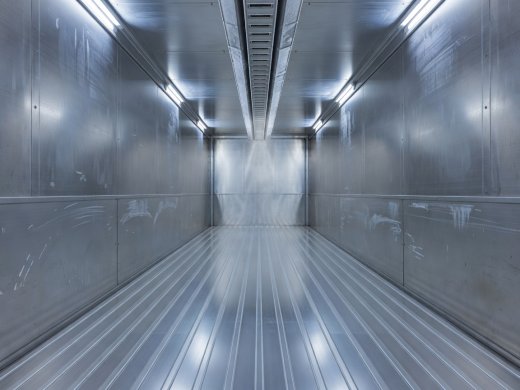
Closed-cell polyurethane foam does not keep its factory K-value indefinitely. Over years of road vibration, thermal cycling, and moisture diffusion into microscopic cells, insulation efficiency degrades by roughly 3% to 5% per year. A ten-year-old trailer with damaged exterior cladding, waterlogged floor panels, or torn EPDM door gaskets forces its refrigeration unit to run at maximum load continuously, increasing fuel draw and creating sharp temperature differences between the front bulkhead and rear doors.